Five Historic St. Augustine Streets Every Visitor Should Walk

Palm trees line St. George Street in the heart of St. Augustine’s historic district.
A day in downtown St. Augustine never goes exactly as planned. You head toward the Castillo de San Marcos National Monument, then catch the smell of fresh empanadas drifting from the Spanish Bakery on St. George Street. A few minutes later you’re peeking into an art gallery on Aviles Street or squeezing onto Treasury Street to see why a road barely wide enough for a car has become a favorite spot for photographers. Suddenly, the afternoon looks different than it did when you left your hotel.
That isn’t accidental. Before downtown filled with today’s businesses, these historic St. Augustine streets connected important parts of the city under Spanish and British rule. Today, each street has its own character while linking many of St. Augustine’s well-known landmarks together.
Aviles Street
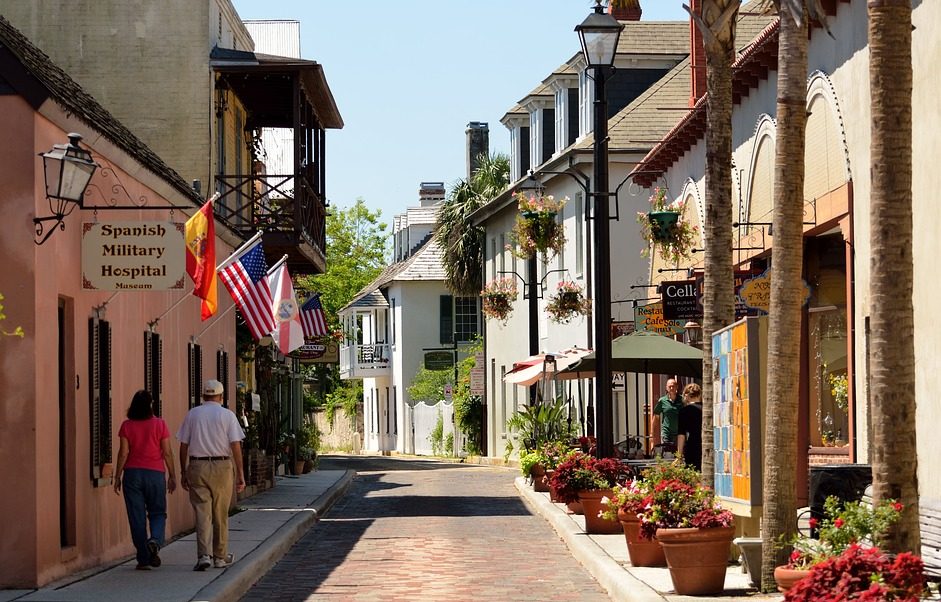
Historic Aviles Street is filled with galleries, cafés, and years of history.
Aviles Street feels noticeably calmer than many of the surrounding streets. There aren’t flashing signs pulling your attention in every direction, or crowds packed shoulder to shoulder from morning until night. Instead, it’s the kind of place where an art gallery, café, or museum convinces you to come inside.
That isn’t a new development. Originally known as Hospital Street, Aviles Street dates back to the city’s earliest Spanish settlement and is widely recognized as the oldest platted street in the United States. Archaeologists have uncovered pottery fragments beneath the bricks dating to the early 1600s, adding another reminder that people have been living, working, and passing through here for centuries.
Today, art has become part of the street’s identity. The Bart on Aviles displays works by nationally and locally recognized artists, while neighboring galleries offer even more local talent to appreciate. Just across the street, the Father Miguel O’Reilly House Museum, the oldest surviving mission-style residence in St. Augustine. A short walk south leads to the Ximenez-Fatio House Museum preserves the history of a nineteenth-century boarding house that welcomed travelers arriving by stagecoach and steamboat.
By the time you’ve finished browsing a gallery or stopped for lunch at one of Aviles Street’s cafés, you’re only a few minutes from St. George Street, Charlotte Street, and the Plaza de la Constitución.
St. George Street
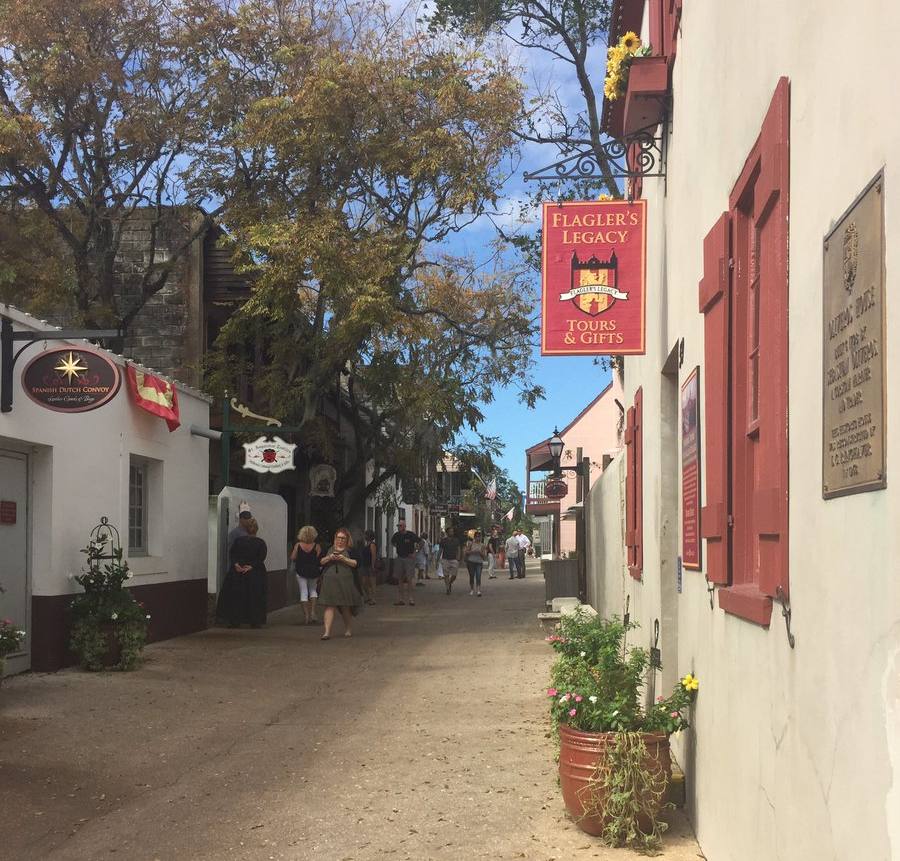
St. George Street is lined with locally owned shops and historic buildings.
It’s easy to tell who has never visited St. Augustine before. They’re the ones stopping every few steps. A candy shop catches someone’s eye. A musician starts playing beneath the shade of an old oak. Someone else is debating between fresh fudge and homemade ice cream while another visitor disappears into a courtyard they hadn’t noticed a moment earlier. On St. George Street, everyone’s looking at something new, which helps explain why no visit lacks surprises.
That steady stream of people stretches back centuries. St. George Street served as the city’s main north-south corridor, bringing homes, businesses, churches, and government buildings together during both the Spanish and British colonial periods. Although today’s storefronts look nothing like those early days, the street has remained a gathering place for centuries.
Many popular attractions are only a few steps apart. Near the northern end, the City Gate marks the historic entrance into the colonial city, while the nearby Castillo de San Marcos National Monument overlooks Matanzas Bay. Continuing south, you’ll pass the Oldest Wooden School House, a cedar and cypress building constructed in the 1700s that survived both the British occupation and the city’s devastating fires. Farther south, the Colonial Quarter gives visitors a closer look at blacksmithing, shipbuilding, and daily life under Spanish rule. In between, independent bookstores, specialty food shops, and longtime local businesses make it a great place for souvenir shopping.
Treasury Street

The easiest way to find Treasury Street is by going to The Peña-Peck House on St. George Street. Photo courtesy of the Woman’s Exchange of St. Augustine.
Blink, and you might walk right past Treasury Street. At just over six feet wide, it’s so narrow that two cars couldn’t pass each other even if they tried. That alone has turned it into a favorite photo stop, but the unusual dimensions aren’t just a quirky piece of trivia.
Treasury Street earned its name from the Spanish Royal Treasury building that once stood nearby, where taxes and royal funds were collected during Florida’s colonial period. Its narrow width also reflects the practical realities of early St. Augustine, when streets were designed for pedestrians, horses, and small carts rather than modern traffic. More than three centuries later, Treasury Street still follows much of its original footprint, giving visitors a rare chance to see how compact the colonial city really was.
Despite its size, Treasury Street sits in the middle of several important landmarks. Walk its full length, and you’ll cover the distance in well under a few minutes, though many visitors spend more time taking photos than actually crossing the street.
Charlotte Street
Charlotte Street keeps your eyes looking upward. Between the historic homes, balconies, churches, bed & breakfasts and centuries-old architecture, there’s just as much to notice above eye level as there is in the storefront windows. It feels like a street that encourages curiosity, especially once you leave the busier blocks behind.
That mix of old and new has defined Charlotte Street for generations. During the British period, the street was renamed in honor of King George III’s wife, Queen Charlotte, though its roots reach back to the city’s Spanish colonial years. Over time, homes, businesses, religious buildings, and civic landmarks all found a place here.
Charlotte Street gives the rooftops and bell towers a chance to steal the show. The Cathedral Basilica of St. Augustine stands nearby with its striking bell tower and Spanish Renaissance Revival design, while the Governor’s House Cultural Center and Museum showcases Florida history through rotating exhibits and archaeological collections.
Charlotte Street doesn’t announce itself the way St. George Street does. Instead, your attention drifts toward wrought-iron balconies, historic markers, and architectural details that are easy to miss when you’re focused on reaching the next attraction.
Marine Street
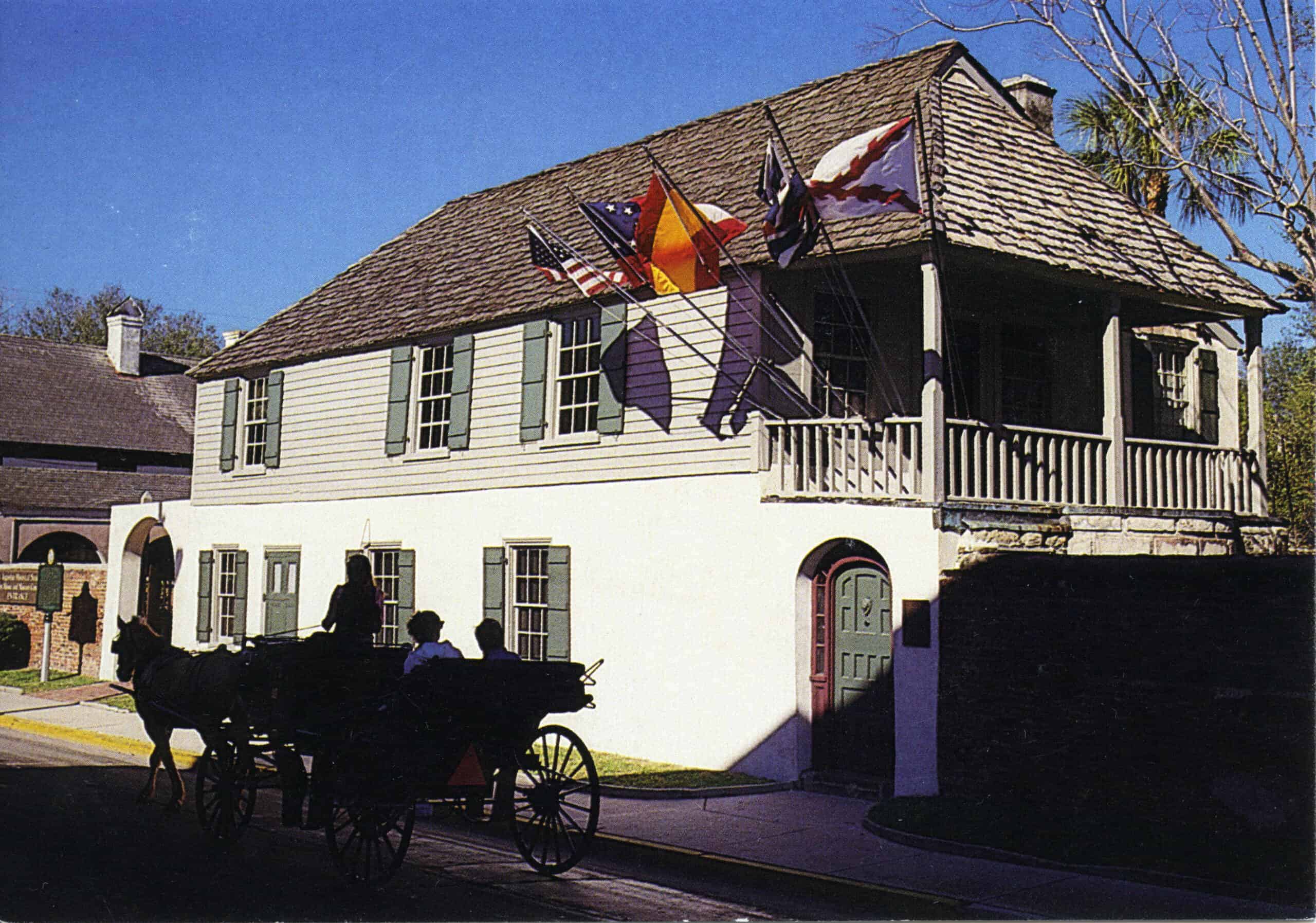
The González–Álvarez House, known as the Oldest House, can be found near Marine Street.
Marine Street feels like a reminder that downtown St. Augustine wasn’t built entirely for tourists. Historic homes sit behind picket fences, front porches still welcome afternoon conversations, and everyday life continues only a few blocks from some of the city’s busiest attractions. That balance has always been part of Marine Street’s character.
The street takes its name from the marine encampments that occupied this area during Florida’s Second Spanish Period, when soldiers stationed near the bay lived and trained within walking distance of the city’s defensive walls. St Francis Barracks, today known as State Arsenal, is the headquarters of the Florida National Guard. Officers homes as well as the National Cemetery is located on Marine Street. As St. Augustine grew, Marine Street gradually became a residential corridor while keeping much of its historic character intact. Today, you’ll find everything from modest nineteenth-century cottages, larger Victorian-era homes, to a military presence which gives the street a feel that’s noticeably different from the commercial blocks farther north.
The St. Augustine Lighthouse & Maritime Museum is only a five-minute drive across the Bridge of Lions on Anastasia Island, while downtown’s museums and restaurants remain close enough to reach on foot in about 15 to 20 minutes. Marine Street won’t appear on every tourist’s list, and that’s perfectly fine. It doesn’t need to. Spending a little time here rounds out your visit to an area of St Augustine that many people drive past without ever noticing.
Skip the Shortcut, Not the Historic St. Augustine Streets
The next time your plans require you to go through the historic district, don’t be surprised if Treasury Street pulls you in for a photo, Charlotte Street has you admiring rooftops instead of storefronts, or St. George Street sends you down a side street you hadn’t noticed a minute earlier. Chances are, you’ll also find yourself lingering on Aviles Street or taking a quick drive over to Marine Street before calling it a day.
Looking straight ahead on any of these streets almost feels like a missed opportunity. Google Maps will probably disagree, but downtown St. Augustine has always made a pretty good case for taking the long way.
Frequently Asked Questions
Which historic St. Augustine street is the oldest?
Aviles Street is widely recognized as the oldest continuously occupied street in the continental United States. Dating back to St. Augustine’s early Spanish settlement, it’s now home to art galleries, museums, cafés, and some of the city’s oldest architecture.
Can you walk to all of these historic St. Augustine streets?
Yes. Aviles Street, St. George Street, Treasury Street, and Charlotte Street are all located within St. Augustine’s historic district and are only a few minutes apart on foot. Marine Street sits farther south, about a 15 to 20 minute walk from the Plaza de la Constitución, though many visitors choose to make the short drive instead.
Which historic St. Augustine street is usually the busiest?
St. George Street sees the largest crowds throughout the year because it’s lined with restaurants, specialty shops, attractions, and historic sites. Midday, weekends, holidays, and the annual Nights of Lights celebration are typically the busiest times. If you prefer a quieter visit, weekday mornings usually offer a little more room to explore.
How long does it take to explore these historic St. Augustine streets?
Walking all five streets doesn’t take very long, but exploring them usually does. Between galleries, museums, local shops, restaurants, and historic landmarks, many visitors spend several hours wandering the historic district without realizing how much time has passed.
Which street is best for shopping and local businesses?
St. George Street has the largest concentration of shops, candy stores, restaurants, and specialty retailers. Aviles Street is a great choice if you’re interested in local art galleries and smaller businesses, while Treasury Street, Charlotte Street, and Marine Street are better suited for sightseeing, architecture, and history than shopping.
What’s the best way to explore historic St. Augustine streets?
Start with a destination if you’d like, but don’t feel obligated to stick to the shortest route. Some of the best discoveries happen when you turn onto a side street, stop at a place that catches your attention, or spend extra time exploring somewhere you hadn’t planned to visit.
Disclaimer: Every effort is made to ensure the accuracy of information on the City Blog.
Sharing and re-posting this blog is encouraged.
The post Five Historic St. Augustine Streets Every Visitor Should Walk appeared first on St. Augustine, FL | Oldcity.com.


 George Washington never physically set foot in St. Augustine, but his attention was very much focused here. During the Revolutionary War, St. Augustine was a British stronghold, and Washington understood its strategic importance. Letters from 1775 show Washington monitoring the city as a military concern.
 If one building could claim to be the center of St. Augustine’s presidential story, it’s the Hotel Ponce de Leon. Built by Henry Flagler in 1888, this Spanish Renaissance masterpiece became the winter palace for America’s elite.
 This year’s Presidents Day is particularly significant. In honor of America’s 250th anniversary, Florida has designated Presidents Day 2026 as an official state holiday, giving residents and visitors an extra day to explore their history.